
Sex Offender Checks in Kleberg County
The free Texas Public Sex Offender Registry is the main public channel for a Kleberg County check. Texas DPS publishes the public subset of registration data sent by local authorities. A person who lives inside Kingsville registers through city police. A person who lives elsewhere in Kleberg County registers through the sheriff. Those local agencies maintain and verify their records, then send the information to DPS for statewide publication.
Start with the smallest reliable set of facts. A full or partial name can locate a known person, while an address, map, city, county, or ZIP route helps with neighborhood awareness. Higher-education and status filters can narrow a different kind of inquiry. Search results are leads, not a substitute for reading the complete profile. An alias, old address, similar name, or change awaiting verification can affect what appears.
The official search screen shows how the public process begins. The Texas DPS registry source is shown in the image below.
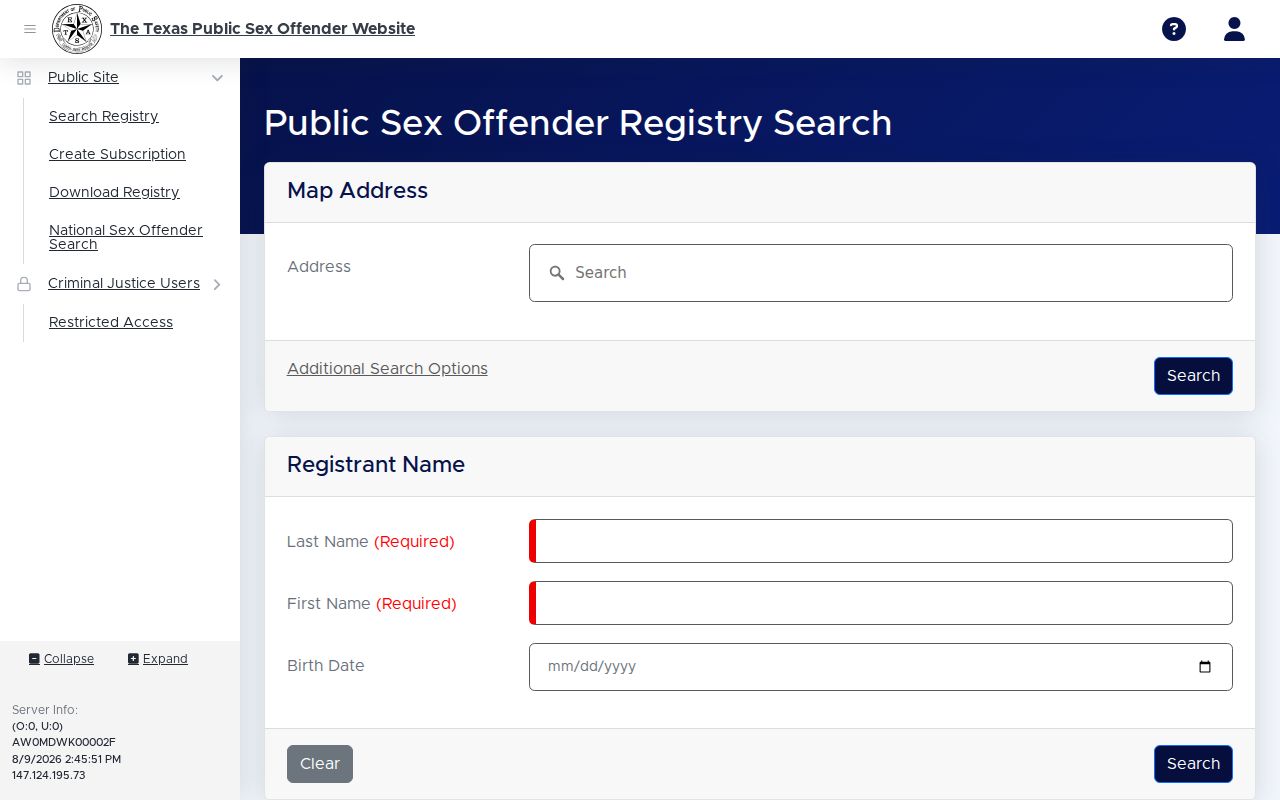
That interface is the correct first stop because it lets readers choose a person-based or place-based search without relying on a private people-finder.
Kleberg County Registry Jurisdictions
The city line determines the local registration authority. Kingsville residents report to Kingsville police, while registrants in unincorporated Kleberg County report to the Kleberg County Sheriff's Office. This split affects where a person should ask about a suspected address change, missed verification, or local compliance issue. It does not create two separate public registries. Both local channels feed the same Texas DPS system.
No verified registration-unit hours or appointment page was found for either local agency. Call before traveling. The sheriff operates from the Kleberg County Law Enforcement and Detention Center at 1500 E. King Avenue in Kingsville and can be reached at 361-595-8500. Inside the city, use the police department's official channel. For suspected noncompliance, contact the authority responsible for the registrant's location or call the DPS Sex Offender Registration Program at 512-424-2800. Call 911 only for an emergency.
How to Search the Texas Public Sex Offender Registry
The state registry accepts several routes because not every safety question begins with a known name. DPS offers name, address or map, place, higher-education, and selected status searches. Exact map radii and live dropdown choices can change, so use the labels shown on the current form. The program page and its public conditions govern the result, not a saved screenshot.
- Open the official Texas DPS registry and read its conditions of use.
- Choose a name, address or map, city, county, ZIP, higher-education, or available status route.
- Enter the facts you know, select Kleberg County or Kingsville when relevant, and run the search.
- Open the likely profile and compare aliases, physical details, address status, offense, and verification information.
| Search mode or field | Type | Required | Notes |
|---|---|---|---|
| Name | Text or mode | Route-dependent | Use first and last name; aliases may appear. |
| Address or Map | Location mode | Route-dependent | Supports proximity review; verify the live radius choices. |
| City, County, or ZIP | Text or dropdown | Optional | Use Kleberg County or Kingsville to narrow the result. |
| Higher Education | Mode | Route-dependent | Searches by an institution-related route. |
| High Risk, Civil Commitment, or Absconded | Filters or lists | Optional | Availability depends on the current screen. |
| Search or Clear | Buttons | Not applicable | Runs or resets the form. |
The DPS program description gives context that the form alone cannot. The image below comes from the Texas Sex Offender Registration Program.
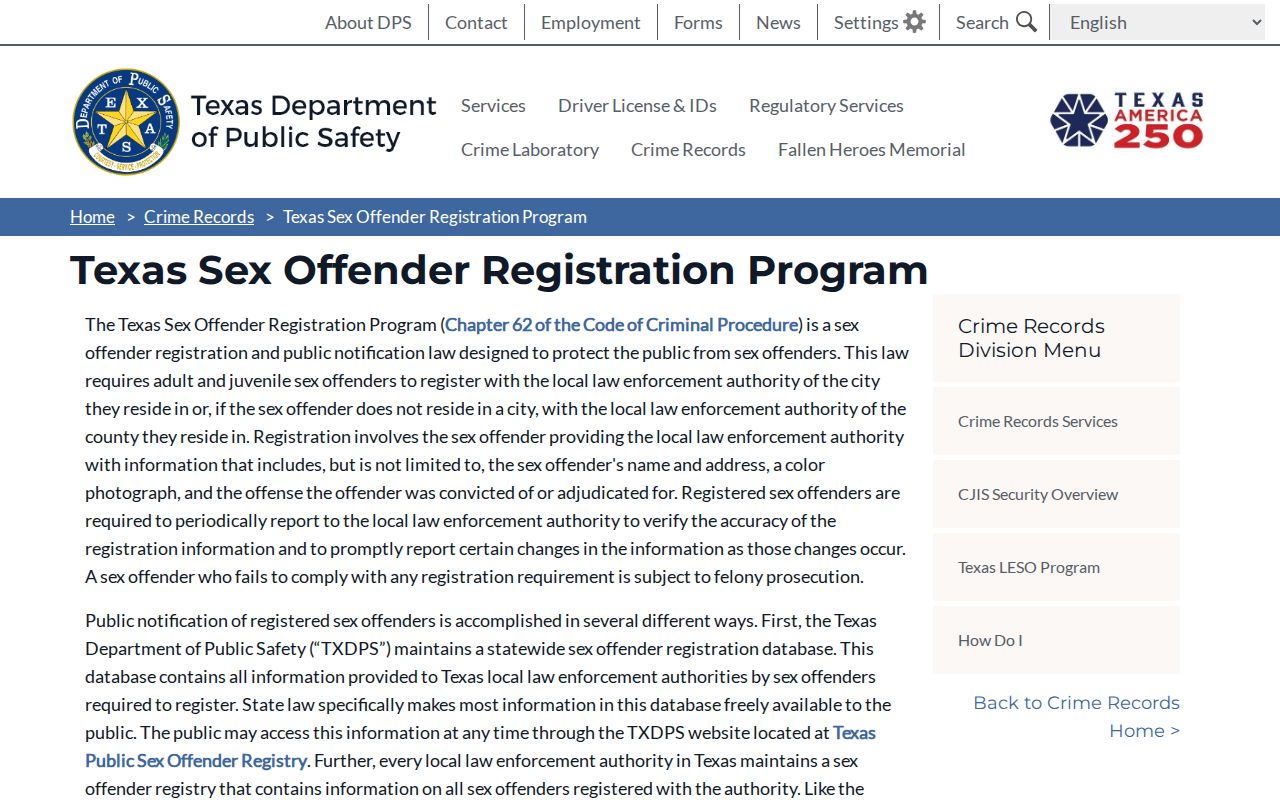
The program material explains why local verification, statewide publication, and community notice are connected parts of one Texas system.
Kleberg County Registry Across States
A Kleberg County search may be too narrow when the person or address history crosses a state line. The U.S. Department of Justice operates the National Sex Offender Public Website, often called NSOPW, as a search layer over participating jurisdictions. Use it after the Texas registry when a former Texas address, an out-of-state move, or a nearby border area matters.
NSOPW does not replace the source registry. Open any promising result and confirm it with the state or territory that supplied the data. Search coverage, public fields, and update cycles depend on each jurisdiction. For a current Kleberg County location, Texas DPS and the responsible Kingsville or county registration authority remain the sources to contact.
The national landing screen shows the broader search route. It is reproduced from the official NSOPW source.
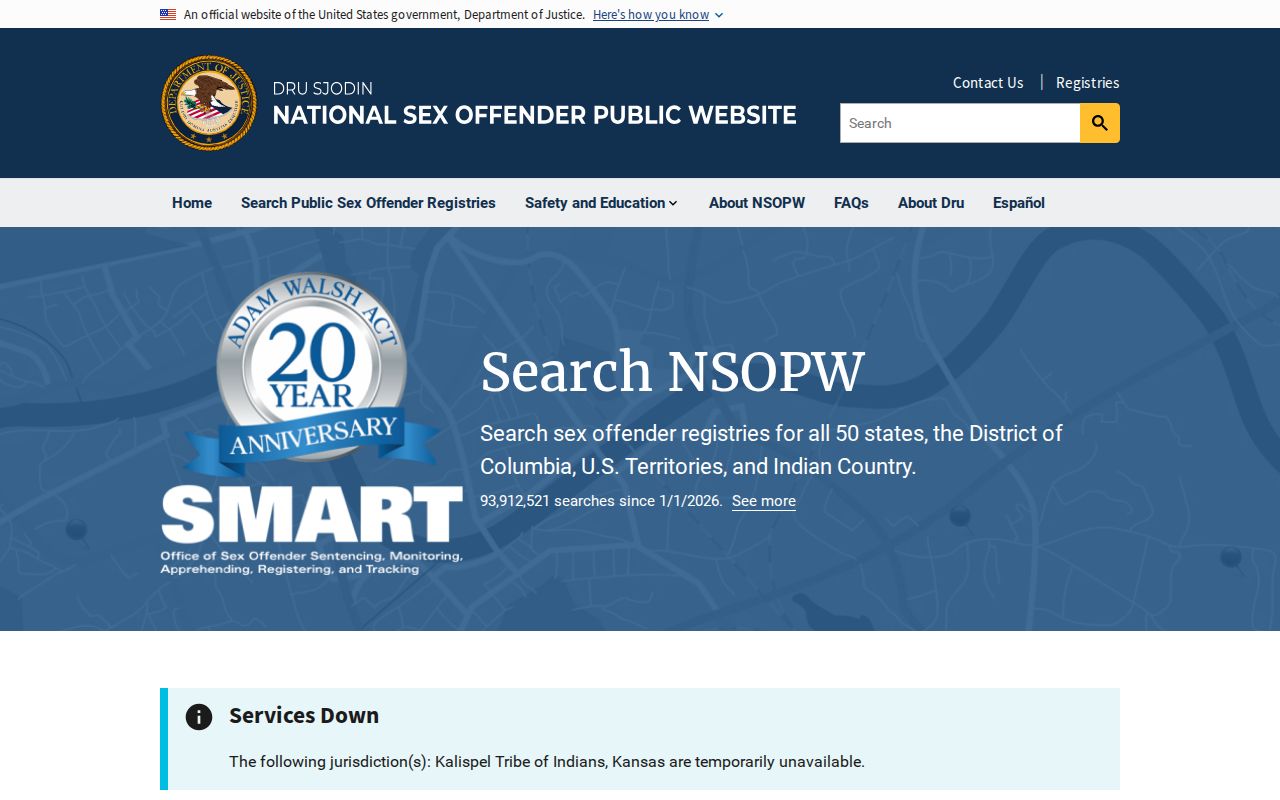
The national layer is most useful for expanding a search, while Texas DPS remains the authority for the details in a Texas profile.
Note: A missing result on one screen does not prove that no registration record exists in another jurisdiction or under an alias.
Inside a Registry Profile
A public profile joins identity, location, offense, and compliance fields. Read them as separate facts. The address describes the published residence or status, while the conviction field identifies the qualifying case. The risk label is Texas's assessment language, not a sentence length or a federal tier. Verification details help show whether the local agency has recently confirmed required information.
| Name and Aliases | Published name forms that can help distinguish a result. |
|---|---|
| Photo and Description | Photo, age or date-of-birth display, sex, race, height, weight, hair, eyes, and identifying marks when public. |
| Address and Status | Published location and registration or absconded status. |
| Offense and Statute | Qualifying offense, legal citation, conviction data, and lawful victim age or sex category. |
| Risk Information | Low, moderate, high, or civil-commitment information where applicable. |
| Verification | Public details tied to periodic confirmation and compliance. |
Some data stays private. The public profile excludes a Social Security number, driver's-license number, phone details, online identifiers, employer details, victim identity, confidential DPS fields, and court-protected juvenile information. The DPS registry FAQ addresses the public program and its limits.
The FAQ helps separate what Texas makes public for safety from the identifiers and victim information the state protects.
Kleberg County Registry Risk Labels
Texas risk labels are not the federal SORNA tiers often described on national sites. Low means the person is assessed as posing low danger and being unlikely to reoffend sexually. Moderate means moderate danger and a possibility of continued offending. High means serious danger and an assessment that offending will continue. Civil commitment is a separate court-designated status for a sexually violent predator.
Do not derive the registration term from the risk word. Texas duration turns on the offense, statute, age, and case circumstances. A high label can also trigger enhanced notice, while civil commitment carries its own status and frequent verification. The profile's offense and registration facts are therefore more useful for duration than a one-word risk label.
Texas Registration Levels and Requirements
Adults generally register for life or until ten years after the later of dismissal or discharge, release, or discharge from supervision. Lifetime categories include DPS-listed sexually violent offenses and specified repeat or circumstance-based offenses. A juvenile adjudication generally requires registration until ten years after disposition or completion, whichever is later. These are broad Texas rules, so the profile and qualifying statute control a specific record.
| Texas label or category | Duration relationship | Verification information |
|---|---|---|
| Low | The label itself does not set duration. | Periodic verification applies under the governing category. |
| Moderate | Use the offense and statute, not the label. | Periodic verification applies under the governing category. |
| High | May be ten years or life based on the offense. | Can bring enhanced community notification. |
| Two or more sexually violent offenses | Often within a lifetime category. | Verification every 90 days. |
| Civil Commitment | Separate court-designated status. | Verification every 30 days. |
Registrants must also report required changes. A failure to comply can be a felony. The governing source is Code of Criminal Procedure Chapter 62, which sets the registration and public-notification framework.
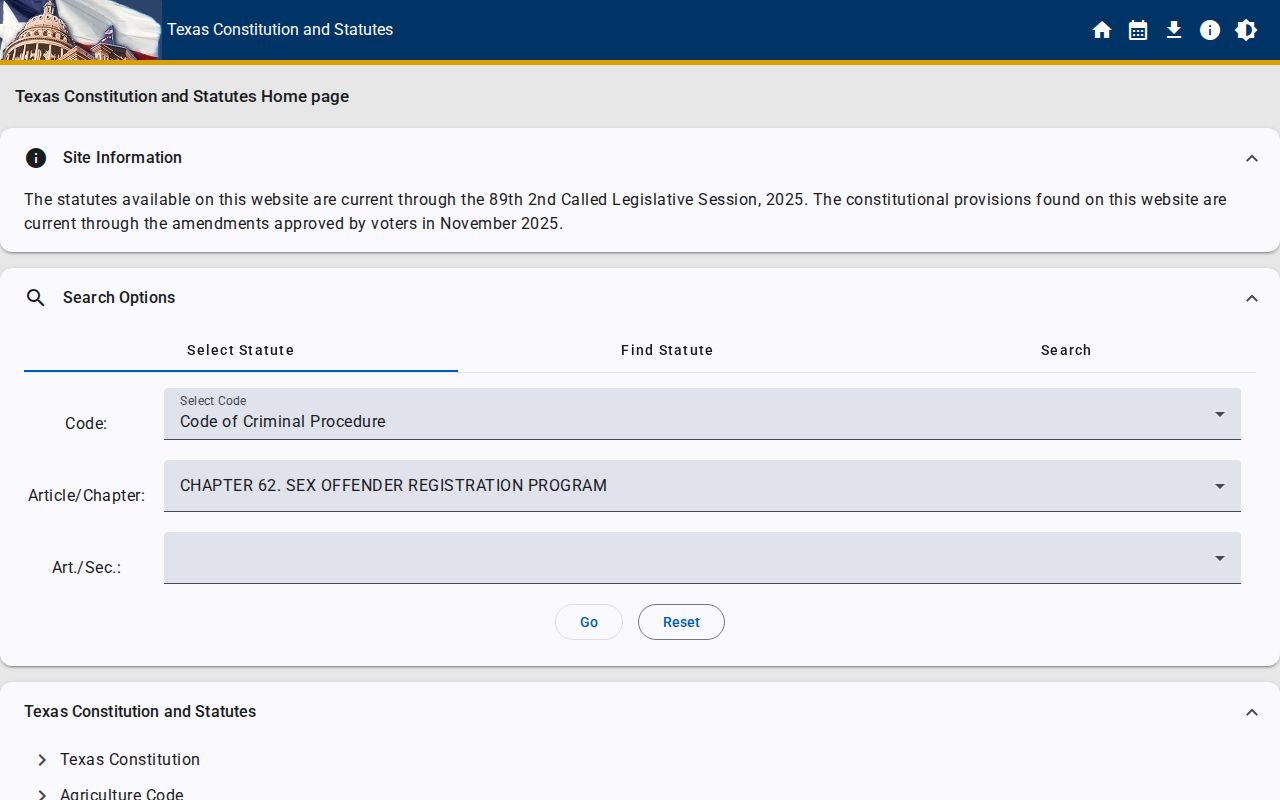
The statute is the controlling source when a summary table and a specific registration duty appear to conflict.
Kleberg County Registry Radius Rules
Texas does not impose one universal statewide residence radius on all registrants. That means a map circle should not be read as a statewide rule that bars every registered person from living within that distance of a school, park, or child-care site. A search radius is a way to find public profiles near a point. It is not proof of a violation.
Local ordinances, supervision terms, parole conditions, or a court order can still impose limits in an individual setting. Verify a current rule with the authority that issued it before drawing a conclusion from an address. For a Kingsville address, start with the city. For an unincorporated Kleberg County address, start with the sheriff. A public profile cannot display every private supervision condition.
Note: Treat map distance as a search aid, then confirm any claimed restriction through the responsible court or supervising authority.
Kleberg County Registry Notifications
Texas DPS publishes the online registry, and local or school notice occurs when the law requires it. DPS also sends English and Spanish postcards when a person classified as high risk or civilly committed moves into a community. The notice is targeted public-safety communication, not a complete list of all registrants in Kleberg County.
The Texas DPS mobile app adds location, name, route, and proximity registry searches. It can help a resident check an area while traveling, but the official profile still deserves a full read. No Kleberg County Sheriff's Office registry app was found. For a concern about a missing update or possible noncompliance, report the facts to Kingsville police, the sheriff, or DPS rather than confronting the person.
Community Notification and Lawful Use
Registry information exists for safety planning and community awareness. It should be used to understand a published record, discuss age-appropriate safety steps with family, or share a concern with law enforcement. It should not be used to expose protected victim details, spread a claim the profile does not make, or organize direct action against a registrant or household.
Government Code Section 411.135 authorizes public access to sex-offender information, while Chapter 62 defines the registration program. Public access does not erase other criminal laws or create permission to injure, harass, or threaten someone.
Use registry data lawfully: Texas law prohibits using public registry information to injure, harass, or commit a crime against a registrant or household. Report a safety concern to law enforcement.