
Checking Criminal History in Kleberg County
Begin with the event, not a broad name query. A recent custody question belongs with the Kleberg County Jail. A Class A or B misdemeanor file belongs with the County Clerk, while a felony file belongs with the District Clerk and 105th District Court. Kingsville Municipal Court keeps fine-only city matters. Texas DPS is the next layer when the goal is public statewide conviction or deferred-adjudication data. For identity-confirmed review of your own Texas record, use fresh fingerprints through FAST and the DPS personal-review procedure.
The official Kleberg County gateway shows where local departments fit within county government.
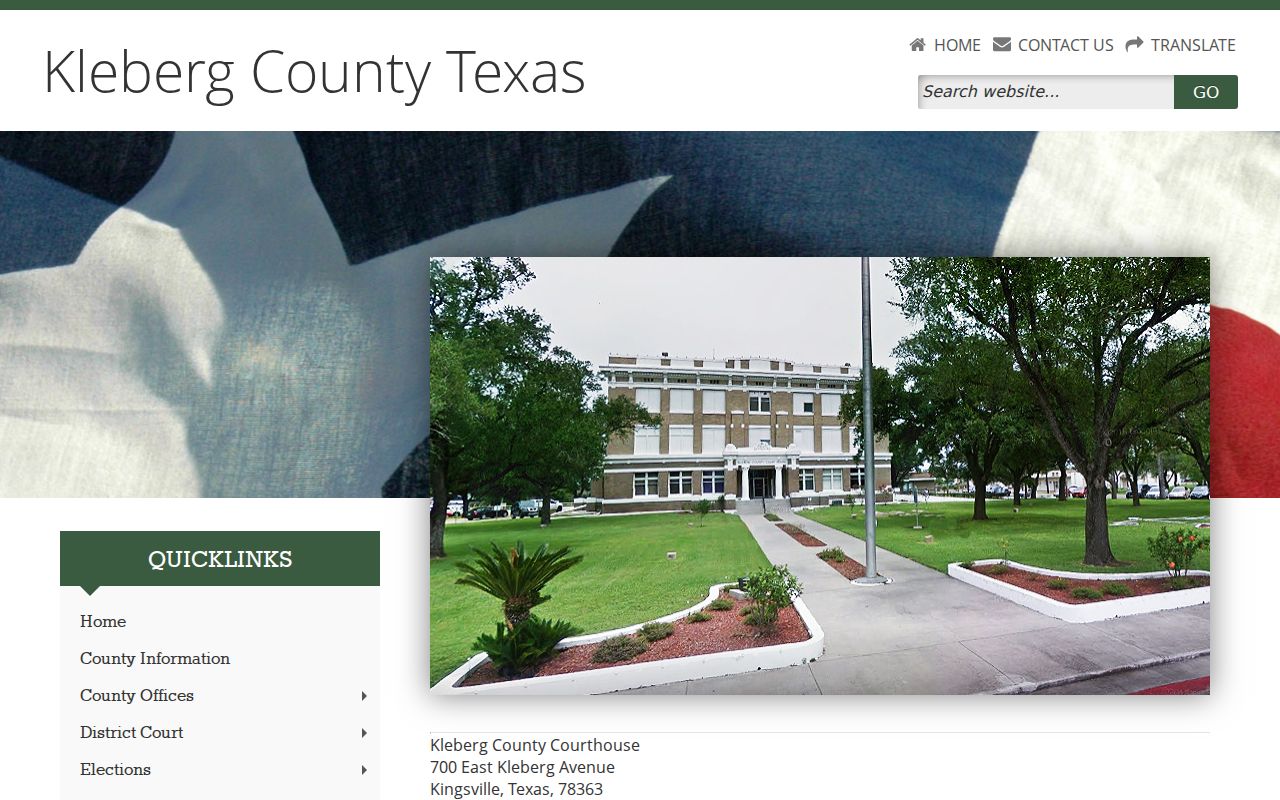
That gateway is useful for confirming the correct custodian before sending a request or making a trip. Then follow the record through each layer that matters.
- Choose the record type and office: jail, municipal court, County Clerk, District Clerk, or DPS.
- Gather a full name, date of birth, case or booking number, likely year, and spelling variants.
- Search the correct index, then compare the court, filing date, charge, and status before accepting a match.
- Request the underlying report, docket entry, judgment, or certified copy when an index lacks needed detail.
- Use a fingerprint personal review for your own record when name ambiguity or completeness is important.
Searching Kleberg County Cases Since 1987
Kleberg County does not offer one complete criminal-record portal. The County Clerk endorses TexasOnlineRecords for county criminal and probate material dating from September 1987. That route is most useful for County Court at Law misdemeanors. Felony records may require direct contact with the District Clerk because the 105th District Court docket is a separate layer. Older files, document images, and records outside the portal's coverage also require help from the custodian.
The Kleberg County Clerk criminal-record page identifies the local search channel and its published access details.
The search result is an index, not positive identification. Match cause number, court, filing year, charge, and disposition. If a felony does not appear, contact the District Clerk rather than concluding that no Kleberg County criminal case exists.
| Search detail | Why it matters | Use |
|---|---|---|
| Name and spelling | Separates exact and variant names | Starting filter |
| Date of birth | Reduces same-name errors | Identity check |
| Cause or case number | Points to one court file | Best exact locator |
| Court and filing year | Distinguishes city, county, and district layers | Coverage check |
| Status and disposition | Separates pending, dismissed, deferred, and convicted | Outcome review |
Texas Official Background Checks
The Texas Department of Public Safety Crime Records Division maintains the state repository. For a Kleberg County search, its public Criminal History Conviction Name Search returns conviction and deferred-adjudication information that Texas law allows DPS to release. An account and prepaid credits are required. Each selected record costs one $1 credit, and a no-hit search still uses the credit. Credit-card purchases add 2.25 percent per credit and 25 cents per transaction. A name response can join records from several Texas counties, but it cannot confirm identity the way fingerprints can.
The Texas DPS criminal-history program page explains the public product and its limits.
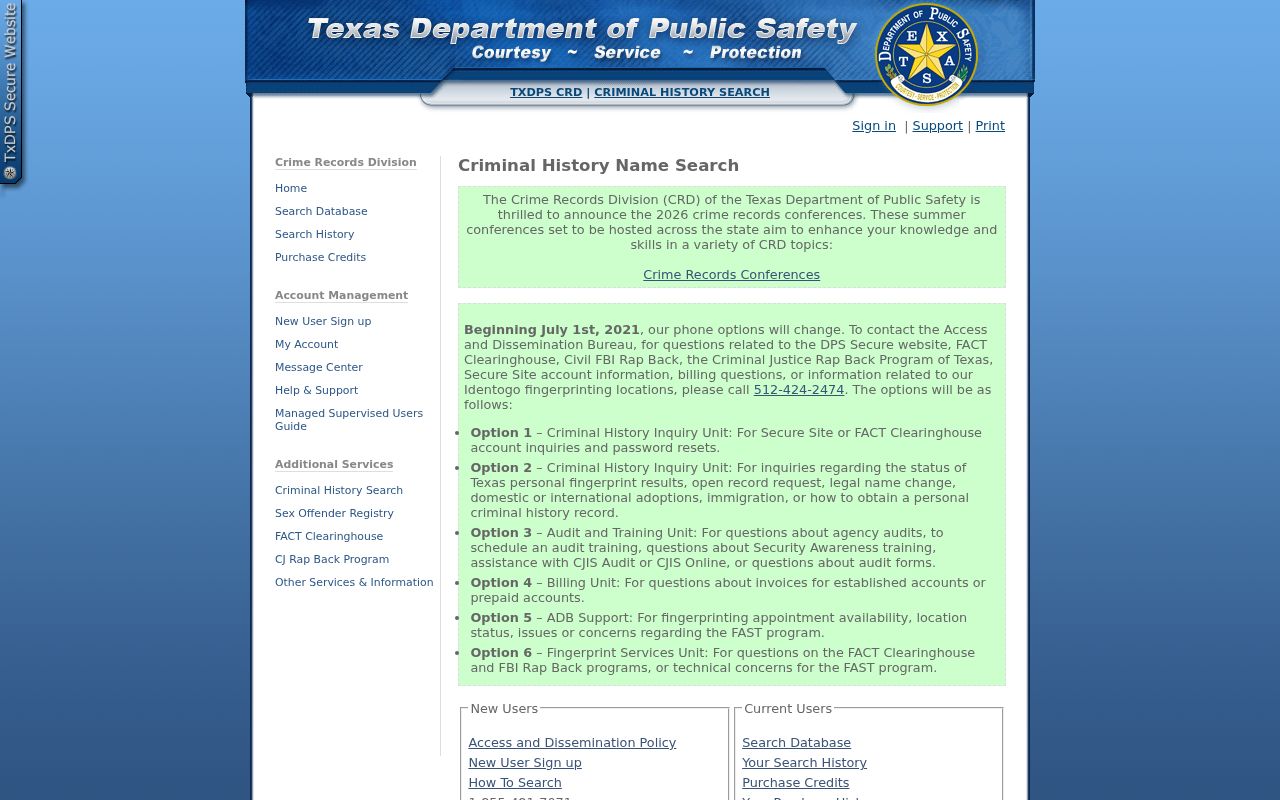
For your own identity-confirmed state record, follow DPS form CR-66 and schedule Fingerprint Applicant Services of Texas through IDEMIA/IdentoGO. The published personal-review cost is $15 for DPS plus a $10 FAST collection fee. DPS estimates about ten business days after receipt, apart from mail time. Current service-code pricing controls.
| Official channel | Record scope | Published base cost |
|---|---|---|
| DPS online name search | Public Texas convictions and deferred adjudications | $1 credit, plus card surcharge |
| DPS offline name check | Public DPS name response | $10 |
| DPS personal fingerprint review | Your identity-confirmed Texas history | $15 DPS plus $10 FAST |
| County Clerk search | Local misdemeanor court file | $10 search |
| County Clerk copies | Paper or certified local documents | $1 per page; $5 certification |
Kleberg County Criminal Record Completeness
A statewide result is only as complete as the reports sent by arresting agencies, prosecutors, courts, and custodial offices. Kleberg County's adult reporting figures show why source comparison matters. DPS measured 1,394 adult arrests and 1,307 complete cycles in 2020, or 93 percent. The completion rate was 97 percent in 2021, then 88 percent in both 2022 and 2023. In 2024, DPS counted 1,883 arrests, 403 no-prosecution reports, 1,132 dispositions, and 1,535 complete cycles, an 81 percent rate.
The DPS Crime Records Division overview places these submissions within the state's criminal-history system.
Across five years, Kleberg County recorded 7,690 adult arrests and 6,859 complete cycles, or 89 percent. These numbers measure reporting completeness, not crime or guilt. A missing disposition may mean lag or an unmatched report. Check the arresting agency, the right clerk, and a fingerprint personal review before deciding that a record is complete or wrong.
Note: A DPS no-hit response does not prove that no Kleberg County incident, booking, pending case, or restricted record exists.
Criminal Record Types
One arrest can produce several Kleberg County records. The arresting agency writes an incident report and probable-cause narrative. Jail staff create the booking entry, fingerprints, photo, intake charges, bond, and release events. Prosecutors select the charges to file. A clerk then keeps the docket, pleadings, orders, disposition, and sentence. DPS joins qualifying fingerprint-based arrest cycles to outcomes reported by the state and local offices.
The sources answer different questions. A booking record shows custody at a point in time. A Kleberg County court file shows the accusation that was filed and how it ended. A warrant belongs to the issuing court and executing agency. Probation and parole are also separate: the judgment establishes community supervision, while TDCJ handles state parole supervision. Registry records follow another statutory system.
- Incident report: the event, location, officer, and releasable narrative held by the creating agency.
- Booking record: intake, agency, charge, bond, custody, and release data held by the jail.
- Court file: filed charge, docket, plea, orders, outcome, sentence, and costs held by the clerk.
- DPS history: reportable Texas arrest cycles and outcomes linked through the state repository.
- Warrant or supervision record: process and status held across courts, law enforcement, probation, or parole.
Why Kleberg County Records Differ
Booked is not convicted. The intake charge reflects what officers brought to jail, while a prosecutor can file a different charge, decline prosecution, or seek an indictment. The clerk's final disposition may be dismissal, acquittal, deferred adjudication, or conviction. Release from jail only describes custody. It does not reveal whether a charge was dismissed or remains pending.
The 105th Judicial District Court page marks the felony court shared by Kleberg and Kenedy Counties.
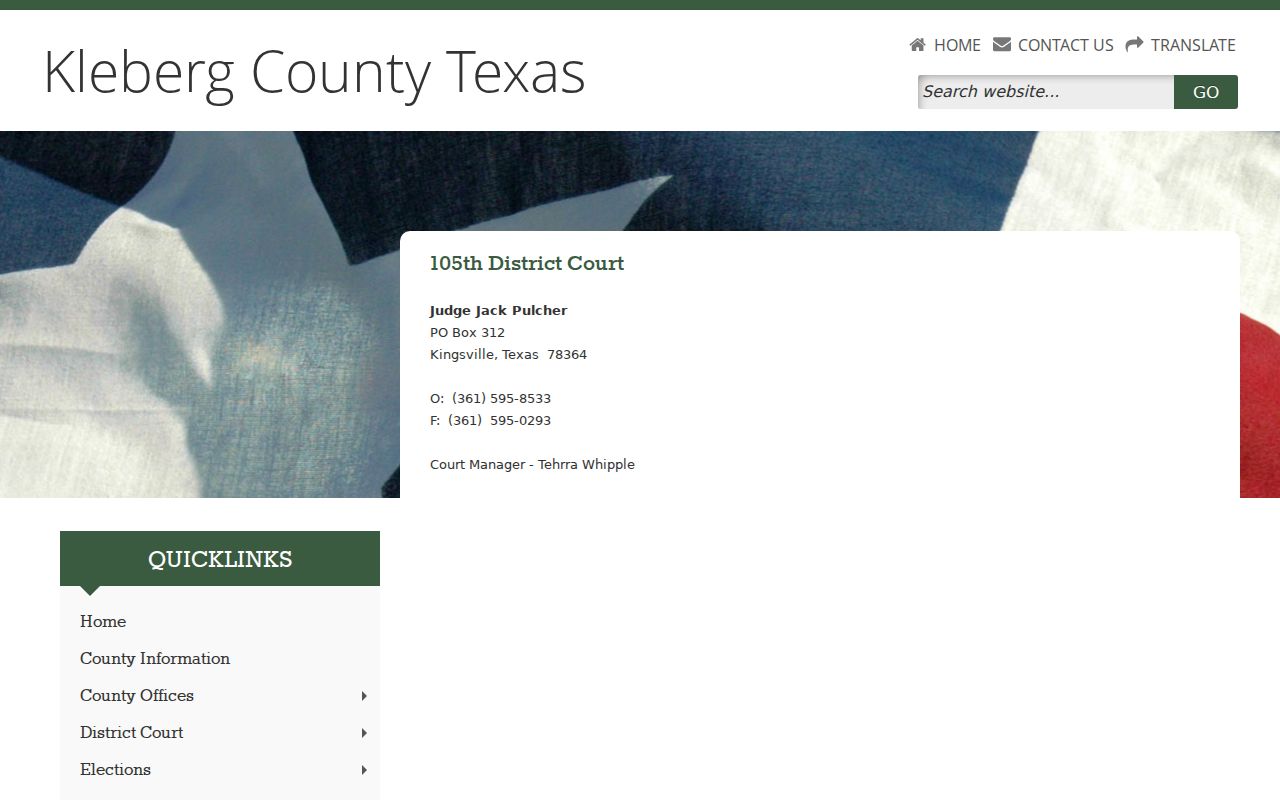
Class A and B misdemeanors are heard in the Kleberg County Court at Law. Felonies go to the 105th District Court. Fine-only Class C, traffic, ordinance, and parking matters can remain in Kingsville Municipal Court or a justice court. That split explains why one search may return nothing while the proper clerk has a file.
| Record | Best question | Main custodian |
|---|---|---|
| Booking | Was the person held, on what intake charge, and when released? | Kleberg County Jail |
| Court case | What charge was filed, and what was the outcome? | County Clerk, District Clerk, or city court |
| DPS history | What public Texas conviction or deferred data was reported statewide? | Texas DPS |
Inside a Kleberg County Criminal Record
Read each Kleberg County record field in its source context. A cause number identifies a court case, while a booking number identifies a jail intake. A charge description may reflect arrest, prosecution, or judgment, depending on where it appears. Dates can mark arrest, booking, filing, plea, judgment, release, or supervision. Status terms deserve equal care because pending, dismissed, deferred, and convicted do not mean the same thing.
| Name & identifiers | Public name and limited identity fields; full state files may include aliases, DOB, SID, and fingerprint association. |
|---|---|
| Arrest & booking | Agency, booking number and time, intake charge, bond, custody, and release events. |
| Charges & statutes | Offense description, class or degree, filing instrument, and cited Texas law. |
| Disposition | Pending, dismissed, acquitted, deferred adjudication, no-bill, or convicted when reported. |
| Sentence | Jail or prison term, community supervision, fine, costs, or restitution where public. |
| Custody & supervision | County jail status, TDCJ custody, probation judgment, or parole status from the proper source. |
- Disposition
- The recorded outcome of a charge, such as dismissal, acquittal, deferred adjudication, or conviction.
- Indictment
- A grand jury's felony charging instrument, not a finding of guilt.
- Community supervision
- The Texas term commonly called probation.
- Capias
- A court order directing that a person be taken into custody.
- No-bill
- A grand jury decision not to approve a proposed indictment.
A public display may omit document images, full identifiers, victim or minor data, and restricted material. Order the underlying clerk record when the displayed fields cannot answer the question.
Kleberg County Criminal Record Offices
Three local offices handle much of the county record trail. The County Clerk is the misdemeanor custodian and publishes a split weekday counter schedule: 8:00 to 11:45 a.m. and 1:00 to 4:30 p.m. The office closes at lunch but says staff may arrange a lunch-hour appointment. The District Clerk maintains felony files for the 105th District Court. The sheriff and jail handle incident, booking, custody, and warrant coordination.
The Kleberg County justice directory gathers the direct numbers for those criminal-record offices.
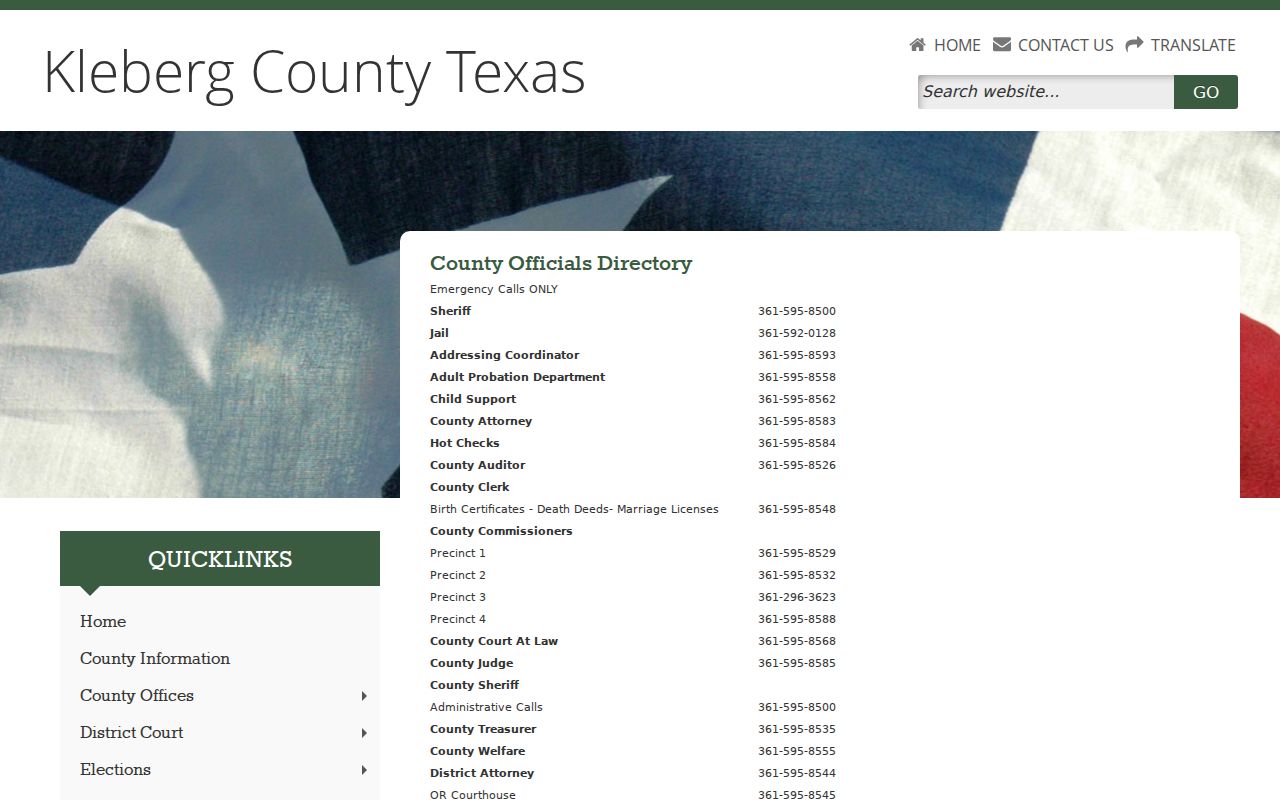
Call before visiting when hours or access rules are not posted. Mailing addresses differ even when a public counter is located at the courthouse.
County Clerk
Kleberg County Courthouse
P.O. Box 1327
Kingsville, TX 78364
361-595-8548
District Clerk
Kleberg County Courthouse
P.O. Box 312
Kingsville, TX 78364
361-595-8561
Sheriff and Jail
1500 E. King Avenue
Kingsville, TX 78363
361-595-8500
Booking ext. 1251
Public Access Laws in Texas
The Texas Public Information Act permits access to existing government records unless law makes the information confidential or an exception applies. A request does not need magic words or a reason. It should name the record, agency, date range, place, incident or case number, and desired format. An office need not answer questions, create a new document, or do legal research. Ask for electronic copies and a cost estimate when useful.
Kleberg County court files also follow court rules and access orders, so a clerk does not treat every judicial record as an ordinary Chapter 552 request. DPS releases only the criminal-history information authorized by Chapter 411. Sensitive identifiers, juvenile material, protected victim data, ongoing-investigation material, sealed files, expunged records, and nondisclosed history may be withheld or redacted.
Key Texas laws:
Government Code Chapter 552 provides the public-information process and its exceptions.
Government Code Chapter 411 controls DPS criminal-history dissemination and nondisclosure.
Code of Criminal Procedure Chapter 55A sets the current expunction framework.
Code of Criminal Procedure Chapter 62 governs sex-offender registration and public fields.
Kleberg County Jail and Warrant Records
The Kleberg County Sheriff's Office publishes Current and Released inmate roster views with name and date navigation. A roster profile can show booking number, booking date, arresting agency, intake charges, aggregate bond, and release status. Charges and bail can change, so booking staff at extension 1251 remain the verification source. The jail's booking process also explains how inkless fingerprints go to Texas and national systems before a court case may be filed.
The official Kleberg County Sheriff page supplies the agency contact route.
Warrant research needs more than a roster. KCSO has a Most Wanted page, but no general active-warrant database exists. Confirm a possible warrant with KCSO, the booking desk if the person is jailed, Kingsville Municipal Court for city failure-to-appear matters, the relevant justice court, the County Clerk for misdemeanors, or the District Clerk for felonies. Texas has no public statewide warrant search comparable to its sex-offender registry.
Write down the issuing office, cause or warrant number, current bond, and accepted resolution method. Obtain a receipt or court order, then recheck the Kleberg County warrant record after processing. Online absence proves nothing, and eBONDS is a post-booking bond service rather than a warrant-clearance tool.
Sealed, Expunged, and Restricted Records
Texas uses two distinct forms of relief. Expunction under Code of Criminal Procedure Chapter 55A directs listed offices and entities to return, destroy, or delete eligible records. An order of nondisclosure under Government Code Chapter 411 blocks general public dissemination but leaves access for criminal-justice and other agencies named by law. A completed deferred adjudication often points toward nondisclosure, not automatic expunction.
Chapter 55A was reorganized in 2025, so an old Article 55.01 checklist can mislead. A Kleberg County expunction case depends on the whole arrest cycle, every charge, the result, exclusions, and the chosen statutory path. Common waiting periods for certain no-charge or dismissal routes are 180 days for Class C misdemeanor arrests, one year for Class A or B misdemeanor arrests, and three years for felony arrests. Acquittals, pardons, and specialty-court paths follow different rules.
For a Kleberg County felony, filing will ordinarily run through the District Clerk, though Chapter 55A includes justice and municipal routes for some fine-only matters. Ask the clerk for current filing costs and local submission rules. After an order, obtain certified copies, confirm distribution, allow time for processing, and use a DPS fingerprint personal review to check your own state record. One clerk's update does not by itself prove that every named recipient processed the order.
Kleberg County Probation Record Trail
Probation and parole do not share one public person search. Kleberg County Adult Probation is the local Community Supervision and Corrections Department channel. The sentencing judgment is the first public source for probation, followed by a request or call for any releasable current status. Supervision notes are not automatically public. A motion to revoke or adjudicate returns an alleged violation to court, where the judge may continue, change, extend, revoke, or adjudicate supervision.
The Kleberg County Adult Probation page confirms the local office and contact line.
Parole is a state track. The Texas Board of Pardons and Paroles makes release decisions, while the TDCJ Parole Division supervises people released on parole or mandatory supervision. Kleberg County parole questions route to TDCJ Region IV through the Corpus Christi district operation. The TDCJ inmate locator and IVSS can show custody or parole status, but absence there does not prove the person has no Kleberg County probation case.
Kleberg County Records Courthouse History
Kleberg County was organized from Nueces County in 1913. Its 1914 courthouse, associated with architect Atlee B. Ayres, remains the local center for clerks, courts, prosecutors, and probation. The building's marble rotunda stairs, etched Mosler vault doors, and preserved furnishings give record custody a visible history. Its original third floor held a courtroom balcony and jailer quarters. The jail moved to the Law Enforcement Center in 1997.
The Kleberg County District Clerk page shows the present felony-record contact within that courthouse system.
Historic details do not set today's hours or access rules. The county department pages and direct clerk calls do. The same care applies to records: the old courthouse houses several related offices, but a request sent to one does not search the holdings of all the others.
Kleberg County Criminal Charge Pipeline
After arrest and magistration, the prosecutor decides what charge moves forward. The County Attorney handles the local misdemeanor track. The Kleberg-Kenedy District Attorney handles felonies presented in the 105th District Court. A complaint or information may support a misdemeanor, while a grand jury indictment is the felony charging instrument. The clerk then preserves the filed case, motions, plea, judgment, sentence, and any later revocation action.
The Kleberg-Kenedy District Attorney page includes local contacts and plea or revocation materials.
TechShare Defense on that page is for counsel discovery, not public Kleberg County case searching. The local plea packets also make an important point: sentencing and community-supervision terms remain judicial decisions. A jail charge, prosecutor filing, and final judgment can therefore describe different stages of the same Kleberg County matter.
Kleberg County Criminal Records by City
Kingsville is Kleberg County's only incorporated municipality, so it is the sole city record guide. Kingsville Police creates city incident and arrest reports, and its Municipal Court holds Class C, traffic, ordinance, parking, and juvenile matters. The city court is not a court of record. County misdemeanor and felony files still move to the proper Kleberg County clerk, while unincorporated Ricardo and Riviera use county systems rather than city police or city court channels.
Kingsville Criminal Records
Population estimate 24,687 · City police reports and Municipal Court records use Kingsville's own access channels.